PUBLIC SPEAKING & PRESENTATION MASTERY
Public Speaking & Presentation Mastery | March 2026
From Panelist to
Powerhouse:
What I've Learned as a Conference Panelist —
and the Secrets That Will Make Yours Unforgettable
FEATURING:"Growing Your Visibility and Brand"
Enterprising Women Conference 2025·New Orleans, LA
with Julie Lilliston & Renée Fraser
Introduction
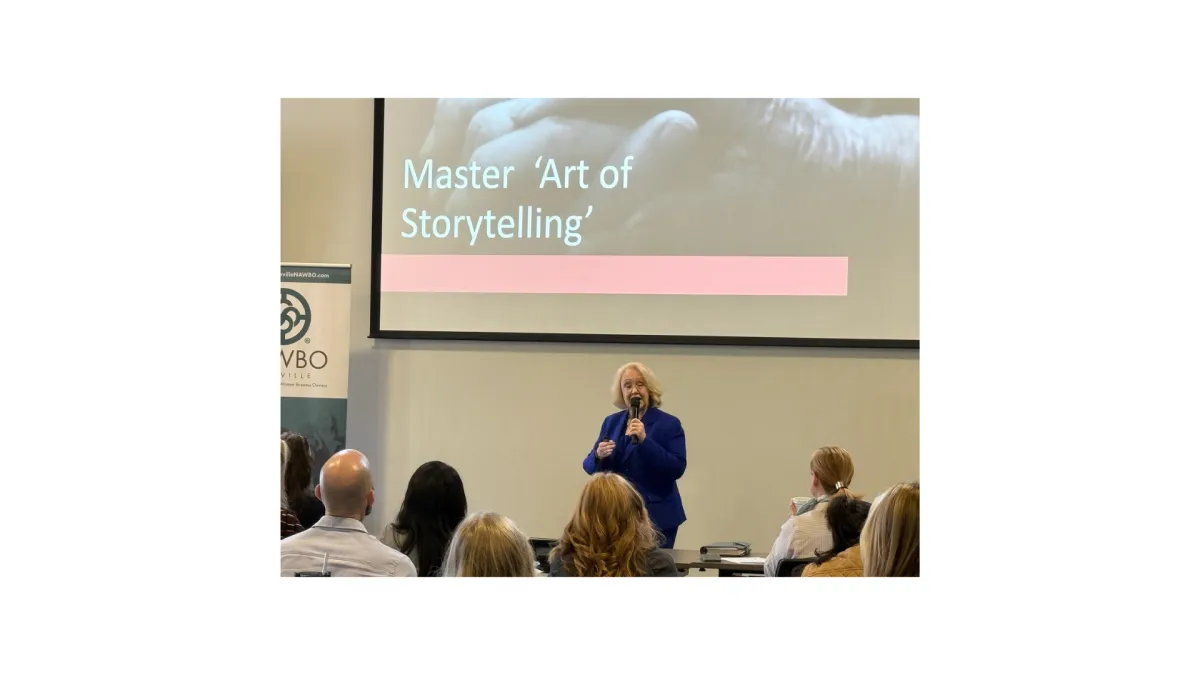
There is something electric about sitting on a conference panel with women who have built extraordinary things. At the Enterprising Women Conference 2025 in New Orleans, I had the privilege — and I do not use that word lightly — of sharing the stage with Julie Lilliston and Renée Fraser for our panel, "Growing Your Visibility and Brand."
Julie and Renée are not just accomplished businesswomen; they are the kind of leaders whose expertise challenges you to bring your absolute best. Julie brings deep insight into strategic visibility and positioning, while Renée's brand-building expertise is grounded in decades of real-world results. Sitting beside them reminded me why preparation is everything — because when you're on a panel with that caliber of co-panelist, you don't just want to show up. You want to add something. You want your perspective to expand the conversation, not echo it.
That's the magic of a well-constructed panel. Each voice should augment the others — different vantage points converging on the same truth, so the audience leaves with more than any one speaker could have given them alone. My lens? The intersection of public speaking, storytelling, and social media consistency as a visibility engine. Where Julie and Renée anchored the strategic and brand dimensions, I was there to show how deliberate communication — on stage and online — closes the loop.
I am generally thrilled to have been on this panel. These are the kind of collaborations that raise your own game - and I left New Orleans more energized about this work ever.
01
Start Before the Panel Starts: Know the Blueprint
Every panel I participate in, I begin the same way: I go back to the original session description. This is non-negotiable for me. That description is the contract between the panel and the audience — it's what people signed up for, and it's your north star.
From there, I review key takeaways, revisit what the panel collectively agreed our focus would be, and clarify what each of us was uniquely bringing to the conversation. This matters because a great panel is not people sharing similar opinions. It's a curated set of distinct perspectives that, together, create something greater than the sum of the parts.
For our Growing Your Visibility and Brand panel, this per-work was critical. It meant I wasn't guessing at overlap — I knew exactly where my contributions would be additive, and I prepared accordingly.
Preparation isn't just about knowing what you're going to say. It's about knowing how your voice fits into the larger architecture of the session.
02
Yes, Bring Your Notes — and Place Them Like a Pro
Let me say this clearly: there is no shame in bringing notes to a panel. In fact, it's a mark of professionalism, not a sign of weakness. I arrived early, connected with Julie and Renée, settled in — and placed my notes discreetly on the table in front of me.
That quiet decision paid dividends throughout the session. When a question surfaced that touched on a point I hadn't addressed yet, a quick glance at my notes told me exactly what I still had to offer. Rather than waiting or losing the moment, I caught the panel chair's eye, gave a small nod, and was brought in to contribute.
Real Talk from the Panel Table
Notes on the table don't read as unprepared. They read as intentional. The audience doesn't see a speaker who forgot something — they see a speaker who made sure nothing important was forgotten. There's a difference.
The feedback I received afterward reinforced this. Our panel chair was generous in sharing that my stories landed well and my answers were strong. That didn't happen by accident. It happened because I had a plan — and the notes to back it up.
03
The Story Bank: Your Most Powerful Panel Asset
If there is one technique, I want every panelist to walk away with from this post, it's this: build a story bank before you ever sit down at a panel table.
A story bank is exactly what it sounds like — a curated collection of real, purposeful stories mapped to the likely themes, questions, and audience moments that could arise in your session. Not a list of anecdotes you might use someday. A ready arsenal of narratives, each calibrated to illustrate a point, demonstrate data, or spark an "aha" moment in the room.
At the Enterprising Women panel, a moment arrived that showed me exactly why this practice matters so much. An audience member pushed back on the idea that social media could build visibility quickly — sharing the all-too-common belief that growing a following takes years before it translates to clients. I had a story ready.
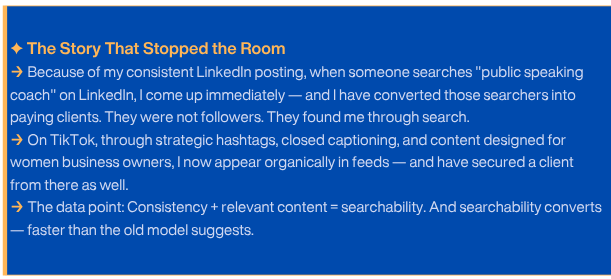
I had planned to tell that story. But the beauty of the story bank is that even when time constraints compress a panel, and not every story can be told, you know which ones to hold and which ones to deploy the moment an audience question creates the opening. That story was exactly what was needed in exactly that moment.
The best panelists don't improvise. They prepare so thoroughly that when the unexpected happens, their response looks effortless.
04
Time Is a Panelist's Currency — Spend It Wisely
Throughout any panel, I am constantly keeping a mental clock. Do I have enough runway to tell the full version of this story? Or do I need to compress it, lead with the punchline, skip the setup? These micro-decisions happen in real time, and they are the difference between a panelist who serves the room and one who inadvertently hijacks it.
A story bank gives you something vital here: flexibility. When you know your stories deeply — when you've told them before, refined them, and understand which elements are load-bearing — you can edit on the fly without losing impact. You can give a 90-second version of a three-minute story and still land the insight.
The goal is always the same: leave the audience feeling equipped, inspired, and moved. That doesn't require more time. It requires the right story, told at the right moment, with the right level of specificity. Preparation makes that possible.
Pop Your Next Panel: The Non-Negotiable
01 Know the other panelists' expertise — and position your contribution as uniquely additive, not overlapping.
02 Return to the session description before every panel. It's your north star and the audience's expectation.
03 Bring your notes — and use them. Arrive early, place them discreetly, and let them be your safety net.
04 Build a story bank. Map real stories to likely questions and themes. Know which to deploy and when.
05 Track time constantly. Know the full version and the compressed version of every story. Stay flexible.
06 Anchor claims with data. Stories that include real results — numbers, outcomes, proof — convert audience curiosity into conviction.